
Do you want to find out more about how a Victorian fireplace is restored? We look at the process of restoring a Victorian fireplace.
Victorian fireplaces are beautiful works of art which brings undisputable class and elegance into a home. Due to their age, unfortunately most will have been damaged during use.
Sussex Fireplace Restoration have years of experience restoring fireplaces back to their former glory; our team are experienced and trained to work with all art styles and materials.
Here are a few common procedures we carry out when restoring victorian fireplaces:
To fully access and replace the tiles, you will first need to remove the grate and fire surround from the cast-iron fireplace; this generally means cheek tiles should only be replaced on a mandatory basis.
Minor flaws such as cracks are not worth the process of replacing tiles or removing any features from your cast iron fireplace. They should prioritise methods such as filling in the cracks via swabbing PVA or epoxy glue combined with talcum powder.
The process to remove the grate, fire surround and ultimately the tiles are as follows; surrounds are often attached via fixings such as ties(marble), screws(wooden and cast-iron fireplaces) or lugs(cast-iron fireplaces) and are discretely covered with plaster.
If you can't immediately find the locations of these fixings, a simple metal detector will suffice and save you any extra damage or wear. Some of the plaster will need to be removed to access and loosen the fixings. It is worth noting surrounds are often comprised of multiple pieces and will come apart once removed from the fixings.
The tiles are typically fixed via a metal frame secured by nuts. Upon removing the fixings, you have access to the tiles. Clean the tiles using thinners or a paint stripper if you're dealing with a black lead, standard bleach for stains or crazing and epoxy or PVA for broken or chipped tiles.
Stripping your surrounds and cast-iron grates is completely safe and considered common practice when restoring your original Edwardian or Victorian fireplaces. It is recommended you wear protection such as gloves and use a poultice as a paint stripper; Nitromors can be used as a substitute.
The substance should be applied using tools such as a filling knife or paint scraper combined with a brush (a household paintbrush will do) to work the substance into any crevasses.
Remove any remaining residue and proceed once the grate is dry. Using a wire brush or steel wool, remove any excess rust, carefully making sure not to scratch the fireplace or details while removing the rust - use rust remover if you need to.
Once most traces of rust have been removed, apply grate polish to the cast-iron grate using a cloth or WD40 for a burnished effect.
Original Edwardian period and some post-Edwardian period fireplaces simulated marble as they painted on substances such as wood or slate to recreate the effect and were adorned with primer and coloured and gliding enamel panels; you must understand the material of your fireplace as paint stripper will cause damage to details or segments of your antique fireplace.
Grates are often fitted with fixings such as wire loops or screws and can often be fitted back the same way they were taken off. Most cast-iron grates fittings will be discrete and covered via plaster and can often be found using a simple metal detector.
On the chance your fireplace doesn't come with any suitable fixings or holes, you can wire around any pegs on the back and create a second loop to provide a little channel in the plaster to screw into the wall.
As a last resort, you can file away to create a smooth and clean surface without any pegs or fixings, then try Araldite or a similar substance to fix the wire to the cast iron. Lastly, apply grate polish if wanted.
The most common variations of original Victorian hearths are tiled and generally restored in the way you would restore cheek tiles.
To fit replacement or repaired tiles, remove any excess cement to provide space for a new adhesive; alternatively, you can glue the tile using a PVA.
A hearth is typically comprised of three parts; the floor, the fire section and the front. The front is the decoration, the fire section sits above the floor and under the fire in an open fireplace, and the floor provides a surface for the hearth and provides protection for the floor against fire - especially wooden floors.
The floor section or the 'main hearth' is a concrete slab around 125mmm thick, extending 500mm from the chimney and 150mm on each side of the chimney entrance at a minimum. Solid flooring allows the main hearth to be used as a constructional hearth; It is recommended you seek advice or tips from a local authority beforehand or expert.
The decorative section is typically a slate comprising of stone, brick or ceramic tiles of 48mm thickness that extends 300mm from the fireplace. The fire section or 'back hearth' should appear flush with the decorative hearth as a 4:1 pre-cast slab mortar or sharp sand and cement.
Major damage will require you to remove the fireplace - blacksmiths can weld for cast iron fireplaces and many other categories surrounding fireplaces.
Any minor damages such as cracks can be filled using fire cement; remove soot using a wire brush or steel wool to create a wider area within the cracks to fill and press with cement using a trowel.
Antique fireplaces can wear over the years, which can lead to a damaged flue; damaged flues increase the risk of a carbon monoxide leak - a potentially deadly but increasingly hazardous gas if left unchecked in your house.
Soot chimney houses are the most at risk, especially if the fireplace is blocked in without any proper ventilation for smoke or gases.
Without ventilation, a blocked chimney will get damp, thus making the soot acidic and attacking the lime mortar.
Carbon monoxide detectors can help you monitor the levels within your house, such as in the bedrooms or living room, and warn you of any leaks, further preventing any harm. Fireplace restoration services can help with gas or smoke leaks and any other issues you have surrounding your fireplace or chimney.
With a bit of DIY know-how, you can do the job of assembling a fire surround yourself. Wooden surrounds are simple; attach small metal plates into the back of the surround, chop a recess into the plaster and lastly, screw into the wall and discretely cover with a plaster.
Wooden or marble slates are more complicated and could need help with alignments such as metal pins or wooden pegs.
Once aligned, you can fix them into place using a fine casting plaster you can acquire at your local hobby store.
Casting plaster can set quickly, so it is best to mix as much as you need per stage and enough that the plaster acts as an adhesive, not to permanently fuse the pieces - as parts could need to be removed at a later date.
Before undergoing this process, it is recommended that you need to get screws, expanded metal mesh or copper wire and 75mm x 25mm wood for props.
Now plaster around the bottom of the jambs from the inside and up the verticals, taking into precaution that the pieces are still aligned.
Next, you should evenly spread a coating layer of plaster atop the jambs to fix the frieze piece in place. Repeat the process for the mantelshelf, using additional plaster at the back to fix the mantelshelf to the wall - using the 75mm x 25mm wood as support to stop any sliding and to keep alignment.
Lastly, wipe off any excess plaster before it can set and apply polish if wanted, and the job is completely done.

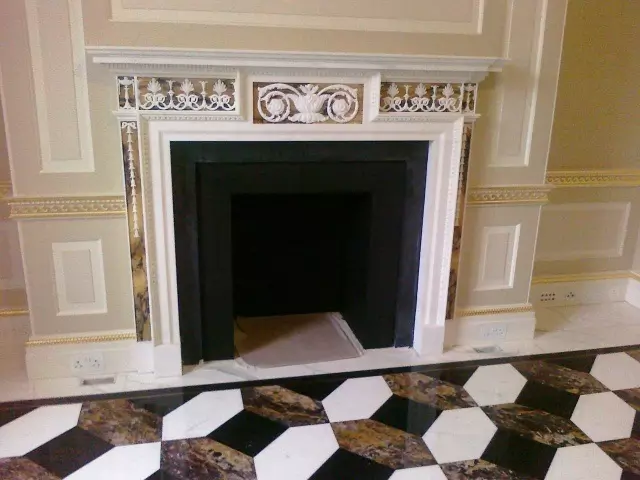

Do you have a Victorian fireplace which needs repair or restoration. If you live in the Hastings and East Sussex area, our expert antique fireplace restoration services can help.